🏢Arena guide · Uptown vs Downtown
New York: the arena that is a building, not a map
Every other arena is a floor with things on it. This one has storeys, staircases and a glass wall you cannot shoot through — and it plays like nothing else in the game.
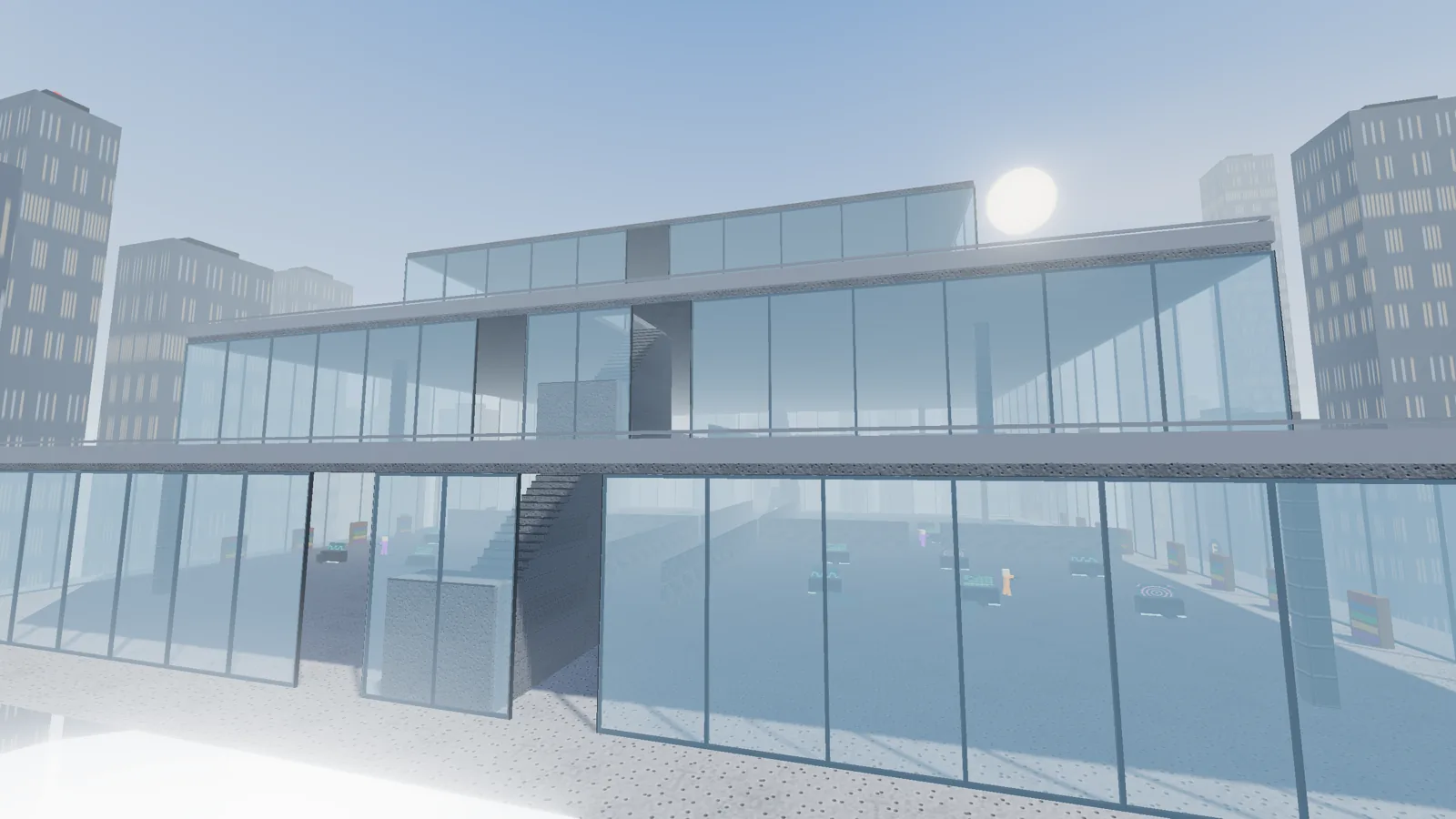
Three floors, and the stairs are the only way between them
The whole arena square is the ground storey. Above it sits a smaller floor, and above that a smaller one again — a stepped tower of three glass office storeys standing high over a daylit city. Each one is a closed room: a full-height glass curtain wall wraps the entire perimeter and a concrete slab caps it. You can see the skyline on every side, and you cannot get out through it.
That leaves the staircases, and they are the whole point of the arena. There are two per floor, north and south, and finding them means going through the offices. You cannot jump between floors, you cannot climb the outside, and you cannot shoot through the glass. If somebody is upstairs and you want them, you walk.
Each staircase is a switchback: two half-storey flights side by side with a landing where they double back. That geometry matters in a fight, because you cannot see the top of a staircase from the bottom of it — and the flight you are climbing has a solid back, so you can walk around it to reach the steps rather than being funnelled straight in.
📐The numbers, as the game actually sets them
- Floors
- Three, each one smaller than the floor below it.
- Storey height
- Nine units from floor slab to ceiling slab — tall, glassy office floors.
- Stairs
- Two switchback staircases per floor, north and south. The only vertical route.
- Curtain wall
- Full-height glass all the way round, with one doorway per side onto the terrace.
- Terrace parapet
- Too tall to walk over, low enough that a jump clears it.
- Office partitions
- Three units tall — well above eye level, so a partition really does break line of sight.
Because each floor is smaller than the one below, every floor's roof is the terrace of the floor above it — and stepping off a terrace is a genuine drop to the terrace, or the plaza, below.
The offices are a maze with furniture in it
Inside each floor is a fit-out rather than an empty box: a central corridor running north to south with two rooms on either side, divided by cross-walls with doorways. The partitions are three units tall, so standing behind one genuinely hides you. You can lose somebody in a room here, which is not true in any of the flat arenas.
The rooms are furnished, and the furniture is cover — desks with computers on them, chairs, couches in the lounge corners, and runs of bookshelves along the window walls. The bookshelves are the useful ones: they are tall enough to hide a standing player, and they sit exactly where you would want to be if you were watching the city side of the floor.

Terraces, parapets and the drop
Because the tower steps inwards as it rises, the roof of each floor is a walkable terrace for the floor above, reached through one doorway per side. A parapet runs round the edge — high enough that you cannot stroll off it by accident, low enough that a deliberate jump clears it.
So the terraces are the one place in the arena where you can change level without using the stairs, and you do it by choosing to jump a wall onto the roof below. It is a one-way move and a committed one, but it is the only way to break a staircase standoff.
🪜A parapet you can jump means every terrace is an exit. If you are losing a floor, go over the edge rather than back down a staircase somebody is already watching.
How the fight actually goes
Vertically separated teams behave completely differently from teams on a flat map. Because the stairs are the only link, they become chokepoints, and a team that takes the top floor has two doors to hold instead of an entire perimeter. The top floor is also the smallest, which cuts both ways: easy to defend, and nowhere to run.
The counter is the terraces. A floor is only sealed if you ignore the outside — attackers can come up a staircase while somebody else drops in over a parapet from the floor above. The arena is at its best once both teams work out that the building has two circulation systems and start using them at the same time.

Six things the tower rewards
- Learn where both staircases are before you need them. Hunting for stairs while being shot at is how floors get lost.
- You cannot jump between floors. If you are separated from your team, the answer is the stairs, not the windows.
- Use the partitions. Three units of wall is a real hiding place, and no flat arena offers you that.
- Bookshelves beat desks. Both are cover, but only one of them hides a standing player.
- Remember the terraces work both ways. If you hold a floor, watch the parapets and not just the stairwells.
- The glass is scenery, not a shooting lane. It shows you the city and nothing else.
Why it is the odd one out
Every other arena in the game is built by tiling one hand-authored block of cover across a grid, which is why they differ by sky and palette more than by shape. New York is not tiled at all. It is authored as a building — slabs, glazing, staircases and furniture — and it is the only arena where the map itself, rather than a movement rule or a hazard, is the thing that makes it play differently.
If you learned the game on the old flat New York city block of containers and catwalks, this is not that arena any more. Same skyline, same two teams, completely different building.
Go and take the top floor
▶ Play now — it's freeFree, in your browser. Choose New York on the setup screen.