🌋Arena guide · Magma vs Obsidian
Floor is Lava: the arena where the ground fights back
Half the floor is molten rock, and every two minutes the rest of it is too. This is what the lava actually does to you, how the map is laid out, and how to survive an eruption.
What the lava actually does to you
Step off the stone and you do not die instantly. You sink to about a third of your height, and from then on you are wading at two-thirds of normal speed while your health drains steadily. From full health that is around six and a half seconds — painful, but never instant. There is always time to get out, and that is deliberate.
The trap is the edge. Once you have sunk, the rock lip you stepped off is above your feet, so you cannot walk back onto it. You have to jump. Players who die in the lava have almost always died trying to walk out of it.
The other half of the rule is the useful half: you only burn while your feet are both low and over lava. Anything that lifts you clears the heat — a jump, a crate, a container. In mid-air you are simply immune. So the arena rewards players who cross the lava in hops instead of treating it as a wall.
📐The numbers, as the game actually sets them
- Sink depth
- You drop about a third of your body height the moment you step in.
- Wading speed
- Two-thirds of normal running speed until you get back onto rock.
- Burn rate
- 15 health a second — roughly 6.5 seconds from full health to melted.
- Safe height
- Feet clear of the surface are out of the heat. Mid-jump counts.
- Jump
- High enough to clear a crate, and long enough to cross roughly five units of ground.
- River width
- Barely more than a stride — less than a third of a jump.
These come from the game's own configuration rather than from guesswork: the arena is tuned so that no gap is unjumpable and no single mistake is instantly fatal.
The map is a grid of roads, not a sea
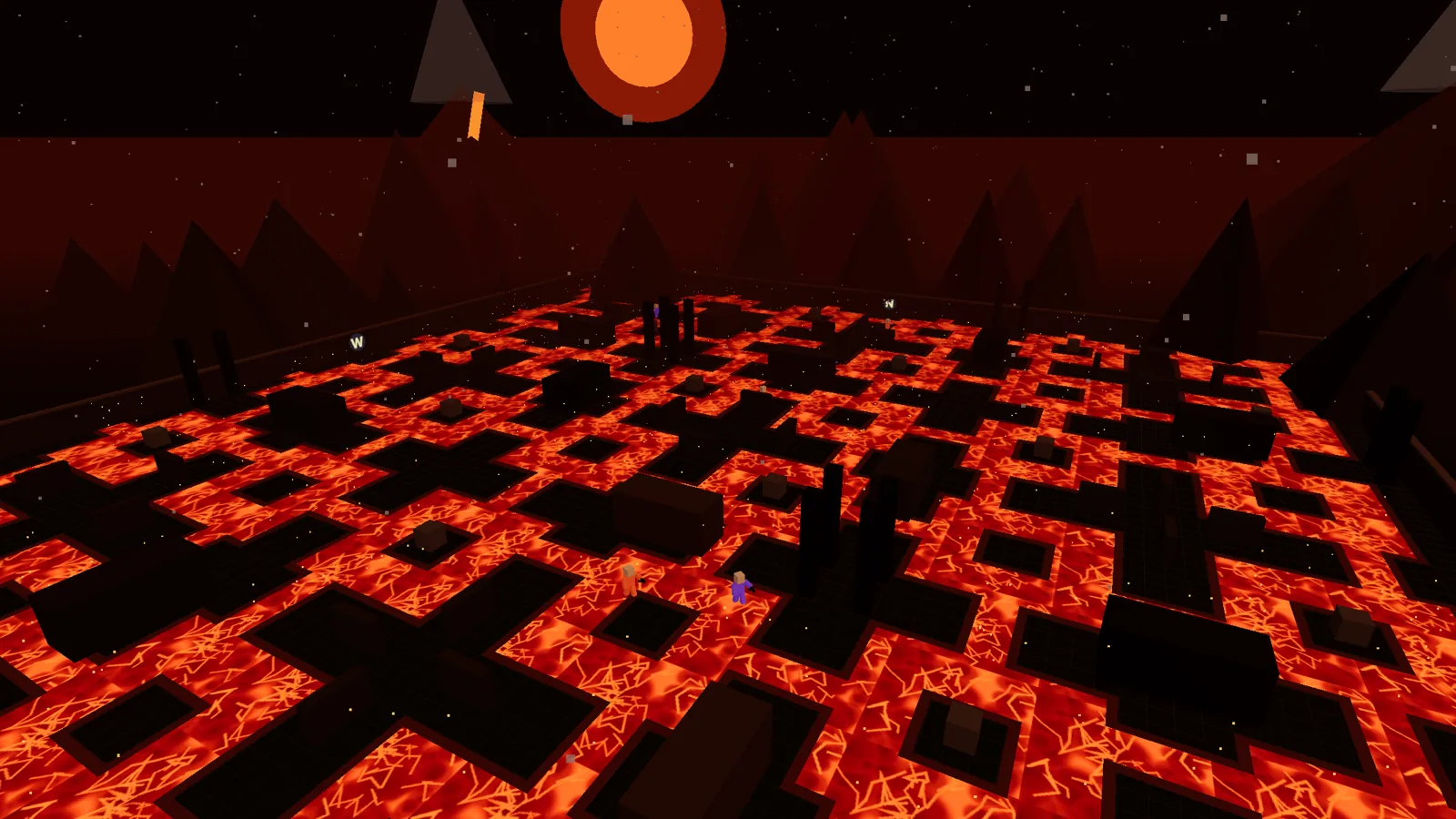
It is easy to look at the arena and see lava with a few paths through it. It is the other way round. The floor is built from repeating 30-unit cells, and every cell is a cross of eight-unit-wide stone roads plus a road along its border — and each border road pairs up with its neighbour's. The result is one connected grid of wide streets covering the whole arena. You can reach anywhere without touching lava.
The lava fills the four quadrants each cell has left over, as a square pool with a safe island punched out of the middle. That is why it reads as rings you hop rather than an ocean you are trapped in. The only lava that crosses a road is a set of narrow rivers spilling across the central crossroads, and each one deliberately stops short of the full road width — so there is always a stone ledge to squeeze round if you would rather not jump.

The eruption: every two minutes the floor stops existing
This is the mechanic that makes the arena. Every two minutes one of the horizon volcanoes blows and lava floods the entire arena — walkways included. For about ten seconds, ground level everywhere is lethal, and the flood burns more than three times as fast as ordinary lava, so standing in it kills in roughly two seconds.
You get five seconds of warning, and the crack that opens on the horizon is your countdown. Five seconds is enough to reach almost anything, and the bar is low: the flood crests just below the height of a crate lid. Any crate, container or pillar will do. You do not need the high ground — you need to be off the floor.
⏱️The eruption runs off the clock rather than off the match, so it lands at the same instant for everybody in the arena — and the Robots scramble for high ground too.
What makes it interesting is that it resets every fight at once. Two players duelling on a walkway both have to break off and climb, and they routinely end up on separate crates staring at each other with nowhere to go. Then it drains and you drop straight back in. It is the closest the game has to a round timer.
Where the power-ups live
The good pickups sit on the islands in the middle of the pools, which puts the arena's best rewards inside the arena's only real hazard. You cannot walk to them. You jump in, land on the island, shoot the pickup — you shoot power-ups in this game, you do not run into them — and jump back out. Anyone watching that pool knows exactly where you are and roughly how long you will be there, which makes a contested island one of the very few places you can genuinely be pinned.

Six things that will stop you dying in the lava
- If you are in it, jump — do not walk. The lip you stepped over is above your feet now.
- Cross rivers at a run and in the air. You cannot burn while airborne, so hopping one costs you nothing.
- When the horizon cracks, stop shooting and find a box. Five seconds is plenty, but only if you spend it climbing instead of finishing a duel.
- During the flood a crate is as good as a container. Extra height buys you nothing at all.
- Treat an island power-up as a commitment. Look at the pool before you jump in, because getting out is slower than getting in.
- The road grid means you are never forced through a pool. If you are taking a lava route, that is a choice.
Why the arena is fair even though it is chaotic
Nothing in this arena is random. The layout is stamped out from one hand-authored cell and is identical on every player's machine, and the eruption is worked out from the clock rather than announced by a server — so every player floods at the same instant without a single network message being sent.
That matters more than it sounds. In a game where the floor periodically kills you, "my screen showed it differently" would be the end of it. Here it cannot happen: nobody gets a different map, and nobody gets a late warning because their connection is slow.
Go and stand in some lava
▶ Play now — it's freeFree, in your browser. Share a code and pick Floor is Lava on the setup screen.